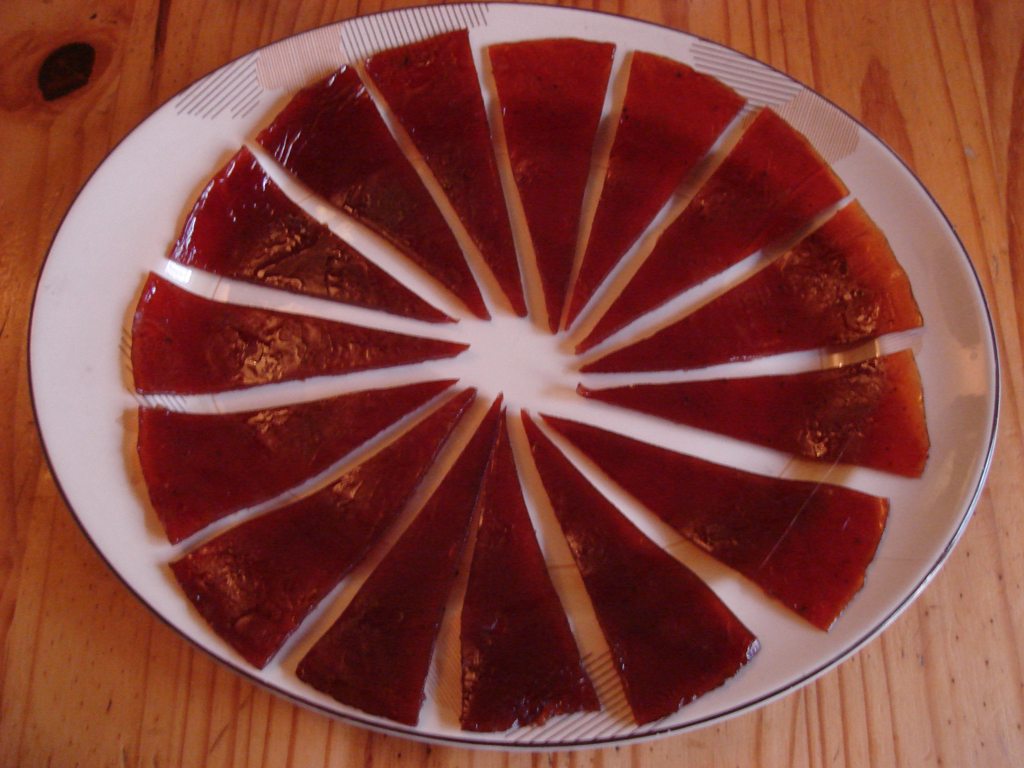
Here we have another esteemed guest blogger joining us with her inspiration and salvage secrets – our auntie Gladys (mum to Brona, also a guest poster of old), who has been busy this autumn in the Rostrevor thicket….
I am excited about having the time and intent to use whatever is available and full of potential so I’ve had a go at using the quince on the neighbours’ bush that they barely knew existed beyond being ornamental. The irony is that one little apple tree has sprouted on our side of their fence right at the quince so the young tree is loaded with bigger apples than any in the old orchard – only a little birdie could have done such a thing…!
With a bit of support from my daughter Alix I harvested about 4lb of quince, wondering if I could make what is called a “spread” with the apples without using sugar as in jam. Finally recipes appeared in search of something I had not seen or experienced before….Membrillo! Now I wondered what it was with no pictures as yet forthcoming so I was blindly crawling before I could walk. After spending time eyeing my basket full of little wizened yellow fruit that bore some resemblance to crab apples for about two weeks, I was still uncertain what to do. Eventually I plucked up enough verve to halve them and remove rotting brown bits or black spots on the skins. I’m blessed to have the use of an old sixty year old Esse stove that still works if properly maintained and I have discovered that the coolest part on top will bring hard fruit towards a luscious pulp by evening with a minimum of added water. The lemon golden pulp when cooled to hand heat was placed in a sieve draped with a small muslim cloth and allowed to drip overnight.
I wondered what to I do next….use this lovely juice only and dispose of all the coarse pulp? Yet again a friend helped unfreeze my mind to shift from the mental mud. I have a sieve acquired from I don’t know where that has a hinged lid enabling contents to be pushed through and transformed into the finest and lightest of consistency. The coarse quince went through to produce a fine pulp which I then blended into a beautiful cream. I knew by this stage that I was getting somewhere but where? Was I going to risk making a spread without sugar that was going to grow a beard by christmas or was the sugar the best solution. I weighed the pulp and added its equivalent in cane sugar into the warmed juice and thanked Gaia for yet another wonder plant to preserve my efforts. I stirred the pot continuously and slowly a clear red golden glaze emerged that brought a smile to my culinary efforts.
Along came another friend at a critical moment to keep me brave for the next decision when this hot pot of gorgeous gold was ready. We poured it onto flat tins lined with oiled greaseproof and placed it for a few hours in the bottom oven where I imagine meringues would crisp without going brown. Later that evening a panicky moment emerged when the top and bottom of the four trays were darkening and losing that wonderful transparent red gold glaze. It was time to rescue them and transfer to the hotpress. I found a way to stack them alongside the stacked towels and there they remained for three to four days slowly drying into what reminded me of turkish delight though in much thinner sheets. It was only then I discovered a site online that sold the spanish membrillo wrapped like the soft galtee cheese triangles that kids love.
 Online I found the spanish cheese recommended to go with this in Sainsburys – Manchengo! Brona had just arrived with Mark who has been christened Tomo or Mr T to differentiate him from son Mark and we had Membrillo straight out of the hotpress with this hard cheese for dessert and a bottle of Reisling. It was a wonderful treat by candlelight and I began to recall stories of Brona as a babe, a physically non stoppable child and bossy adolescent so she bore it all serenely knowing love was in the air!
